EarthSpark International
Eradicating energy poverty in Haiti

Meet the Clean Energy Store Employees and Board
In our last quarterly progress report, we told you about the festive grand opening of our first Clean Energy Store on July 7th in the town of Les Anglais, Haiti. We had high hopes for the store, but knew that many challenges lay ahead. Before the store opened we addressed as many of these challenges as possible: we spent over a year in Les Anglais fielding various surveys to collect market research and create an energy poverty baseline; we brought Diogo Texeira, a retired McKinsey management consultant to work with EarthSpark and our community partners to develop a governance structure, management responsibilities, and a financial accounting system; we brought Bill Nichols, another McKinsey alum, to further develop the operational capacity of the store; EarthSpark Energy Systems Engineer Peter McPhee conducted a week-long training session on solar home system installation and maintenance; the store hosted a team from Fonkoze, Haiti’s premier microfinance institution, to work out the details of our joint “energy lending” program.
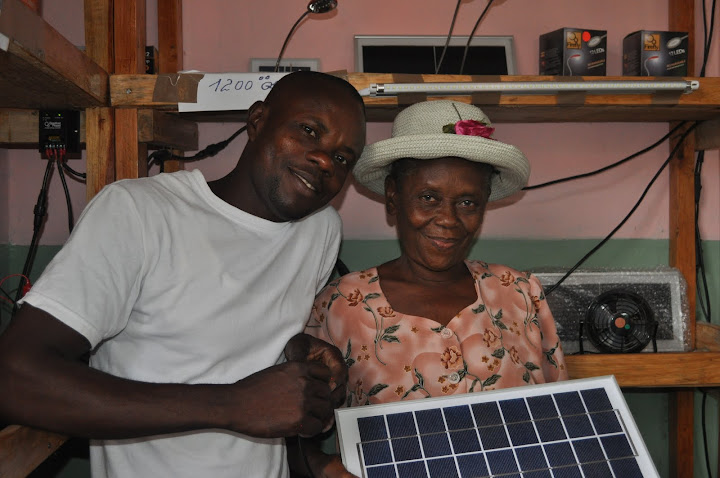
In short, we asked for a great deal of effort from our community partners, while offering little more than the hope that Magazen Eneji Pwop would work in return. After three months of operation, EarthSpark’s President, Allison Archambault and Founder, Dan Schnitzer, visited the store. The first night there, EarthSpark convened a “corporate dinner,” to host the store’s three local members of the board of directors (Dan and Allison are on the board as well), its two-person management staff and three sales agents. During the course of this dinner, we began to understand that success manifests itself in many ways other than sales figures.
We asked everyone at the table to tell us the “story” of the store. In response, most said something similar to "it's hard to start something," or that the "people of Les Anglais appreciate that the store is here," or, "this will grow and get bigger." The store’s assistant manager, Jacqueline, gave the most emotional response, saying "I am proud that Magazen Eneji Pwop is starting in Les Anglais. If ever I am to leave Les Anglais or to die, I hope that eneji pwop will continue to grow in Les Anglais and throughout the country."
Jacqueline’s statement was not the only indication that the store was succeeding on a level beyond the financial. In our meetings over the next two days with the board of directors and store employees, we saw and heard other evidence. The management team had made the risky decision to hire three employees—Juline, Pedro and Jetro. We learned that the risk appeared to be paying off. Before they were hired, the store was selling one or two efficient stoves per day. The stoves, which, at US$3.50, cost just one dollar more than a traditional stove, reduce charcoal consumption by 25 to 50 percent. For a frequent stove user, like a woman who cooks at the market, this efficiency can result in savings of over US$2 per week. Despite these potential savings, sales of the efficient stoves had been weak—just one or two per day. In response to these poor sales, the store launched a “rent to own” program, which essentially provides the consumer with microcredit to make the stove more affordable. Rather than paying up front, a client receives a stove at no charge from a sales agent with the understanding that the agent will return every two weeks over an eight-week period to collect a portion of their charcoal savings. At any point during those eight weeks, the user can opt-out and return the stove to the sales agent. If the user makes all four payments, the sales agent ends up collecting US$6 – almost twice as much as the up-front price of the stove. Since launching this program, the store has sold over 150 stoves—or an average of about five per day. As a result, the store’s three sales agents are earning approximately US$5 per day, about double the earnings of the average citizen of Les Anglais.
Remarkably, not a single client has decided to discontinue payment on their stoves, nor have any been delinquent in repayment. Based on this success, we expect to include other products—like solar desk lamps and small solar home systems—in the rent-to-own financing program.
Two members of the store’s board of directors, Jean and Jean Noel (who is also the store’s manager) lead a 28-person committee to investigate the development of a micro-grid for Les Anglais. We met with representatives from the committee to discuss EarthSpark’s proposal for a solar-powered micro-grid, which would be owned in part by those connected to it. EarthSpark is working with the United Nations Environmental Program, experts from Columbia University’s Earth Institute, and the control system firm Green Energy Corp. on the design of the micro-grid. We expect that the grid will serve its first customers next summer.

1616 H St NW, Suite 900 Washington DC 20006